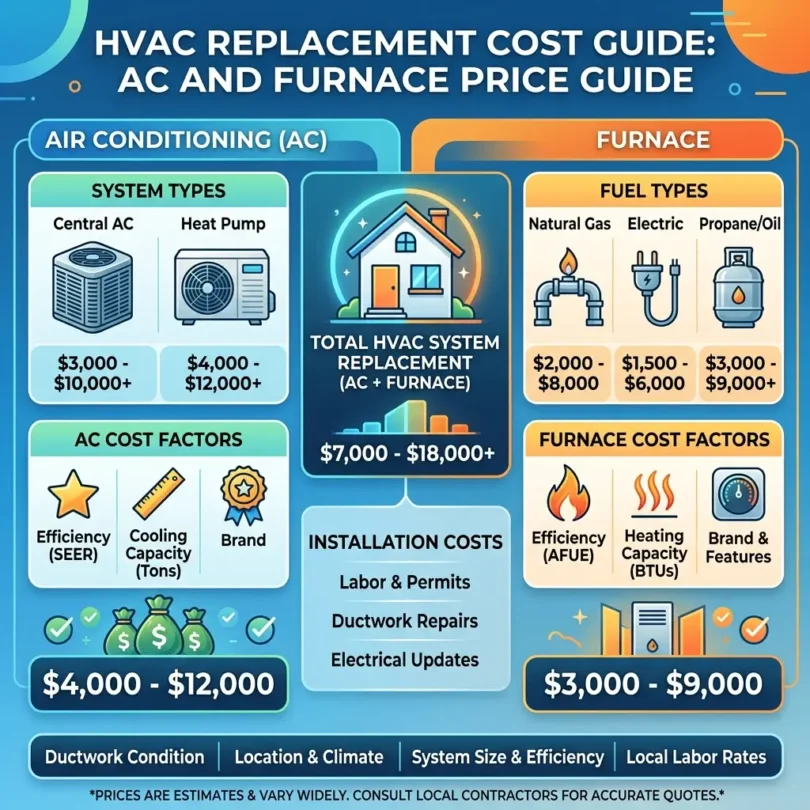

Replacing an HVAC system is one of the biggest home improvement expenses for many homeowners. Your heating and cooling system affects comfort, indoor air quality, energy bills, humidity, and even home value. When an old air conditioner, furnace, heat pump, or full HVAC system starts failing, the repair bills can become stressful quickly.
A weak AC may stop cooling during summer. An old furnace may struggle during winter. A heat pump may run constantly but still fail to maintain comfort. Ductwork may leak air. Poor installation may increase utility bills. If the system is too old, too inefficient, or too expensive to repair, replacement may be the smarter choice.
So the big question is simple:
How much does HVAC replacement cost?
The answer depends on system type, home size, equipment efficiency, ductwork condition, labor rates, installation complexity, permits, location, brand, and whether you replace only one unit or the full system.
In 2026, Bryant says a complete HVAC system replacement can range from $5,000 to $28,000 nationally, depending on system type, SEER2 efficiency ratings, home size, and installation complexity. Trane lists air conditioner replacement at $6,958 to $13,418, furnace replacement at $5,647 to $9,125, and heat pump replacement at $8,889 to $15,437.
This guide explains HVAC replacement cost in simple terms, including AC replacement, furnace replacement, heat pump cost, ductwork, labor, efficiency ratings, repair vs replacement, and how homeowners can avoid overpaying.
What Is HVAC Replacement?
HVAC replacement means removing an old heating or cooling system and installing new equipment. HVAC stands for heating, ventilation, and air conditioning.
A replacement project may include:
- Removing old AC unit
- Removing old furnace
- Replacing air handler
- Installing a heat pump
- Replacing thermostat
- Installing new refrigerant lines
- Inspecting or replacing ductwork
- Updating electrical connections
- Updating gas connections
- Installing drain lines
- Adding permits
- Testing airflow
- Checking system performance
- Setting up warranty registration
A simple replacement may involve swapping an old outdoor AC condenser and indoor coil. A full replacement may include AC, furnace, coil, thermostat, ductwork changes, electrical work, and ventilation upgrades.
The cost depends heavily on how much work is required.
Average HVAC Replacement Cost in 2026
HVAC replacement cost varies widely because homes and systems are different.
A general planning range looks like this:
| HVAC Replacement Type | Estimated Cost Range |
|---|---|
| Central AC replacement | $3,000–$13,500+ |
| Furnace replacement | $4,000–$9,500+ |
| AC and furnace replacement | $5,000–$15,000+ |
| Heat pump replacement | $6,000–$25,000 |
| Air handler replacement | $5,000–$9,500+ |
| Ductwork replacement | $1,000–$6,000+ |
| Full HVAC system with ductwork | $10,000–$28,000+ |
These are general ranges. Your actual cost can be lower or higher depending on your home, location, contractor, system size, and installation requirements.
Angi’s 2026 data says combined furnace and AC replacement costs around $5,000 to $12,500, depending on system type and home size, with labor around $1,500 and additional budget needed for permits and ductwork changes. Carrier says heat pump replacement commonly ranges from $6,000 to $25,000, depending on size, type, labor, and ductwork modifications.
HVAC Replacement Cost by System Type
The biggest cost factor is the type of system you choose.
1. Central Air Conditioner Replacement Cost
Central AC replacement usually includes the outdoor condenser, indoor evaporator coil, refrigerant lines if needed, electrical connections, thermostat updates, and installation labor.
| AC Replacement Type | Estimated Cost |
|---|---|
| Basic central AC replacement | $3,000–$6,500 |
| Mid-range central AC replacement | $6,500–$10,000 |
| High-efficiency central AC replacement | $10,000–$16,000+ |
ConsumerAffairs says central air conditioner replacement costs about $3,000 to $8,000 on average, depending on AC size, brand, and labor costs. Another HVAC provider cost guide lists residential AC replacement around $5,500 to $16,000, including labor and permit fees.
AC replacement cost increases when:
- The home needs a larger unit
- The system has high SEER2 efficiency
- Ductwork needs repair
- Electrical work is required
- Refrigerant lines need replacement
- The old system is difficult to remove
- The home has poor airflow
- The contractor includes a stronger labor warranty
2. Furnace Replacement Cost
Furnace replacement cost depends on furnace type, fuel source, efficiency rating, BTU capacity, venting needs, and installation complexity.
| Furnace Type | Estimated Replacement Cost |
|---|---|
| Electric furnace | $2,500–$7,000 |
| Gas furnace | $4,000–$9,500 |
| Oil furnace | $5,000–$10,000+ |
| Propane furnace | $4,500–$10,000+ |
| High-efficiency gas furnace | $6,500–$12,000+ |
Trane lists furnace replacement at $5,647 to $9,125 nationally. Furnace cost can rise if the system needs new venting, gas line updates, electrical changes, duct transitions, or high-efficiency equipment.
A furnace replacement may include:
- Furnace unit
- Labor
- Gas or electrical connections
- Venting
- Duct transitions
- Thermostat setup
- Safety testing
- Permit fees
- Old unit removal
- Warranty registration
High-efficiency furnaces cost more upfront but may lower heating bills over time.
3. AC and Furnace Replacement Cost
Replacing AC and furnace together can make sense if both systems are old or if you want matched equipment.
| AC + Furnace Replacement | Estimated Cost |
|---|---|
| Basic system | $5,000–$9,000 |
| Mid-range system | $9,000–$15,000 |
| High-efficiency system | $15,000–$25,000+ |
Angi says combined furnace and AC replacement costs $5,000 to $12,500, while one 2026 HVAC installation guide says replacing AC and furnace together usually costs $7,500 to $15,000. Modernize lists the average cost for a 2,000 to 2,500 square foot home at about $13,430 for a combined air conditioning and gas furnace setup.
Replacing both together may save money because:
- Labor can be combined
- The indoor coil and furnace can be matched
- The system may run more efficiently
- The contractor can test the full system together
- You avoid paying for two separate installations later
But if one unit is still newer and working well, replacing both may not be necessary.
4. Heat Pump Replacement Cost
A heat pump can provide both heating and cooling. It works like an air conditioner in summer and provides heat in colder months by moving heat instead of creating it directly.
| Heat Pump Type | Estimated Cost |
|---|---|
| Standard air-source heat pump | $6,000–$15,000 |
| High-efficiency heat pump | $10,000–$20,000 |
| Cold-climate heat pump | $8,000–$25,000+ |
| Geothermal heat pump | $20,000–$45,000+ |
Carrier says most homeowners pay $6,000 to $25,000 for heat pump replacement. Trane lists heat pump replacement at $8,889 to $15,437, and cold-climate heat pump replacement at $8,154 to $17,656.
Heat pumps can be a strong option if:
- You want heating and cooling in one system
- Electricity rates are reasonable
- Your climate is suitable
- You want better energy efficiency
- Rebates or tax credits are available
- You want to reduce furnace use
Cold-climate heat pumps cost more but can perform better in colder areas.
5. Ductwork Replacement Cost
Ductwork is often ignored, but it can strongly affect HVAC performance. New high-efficiency equipment will not work properly if ducts are leaking, undersized, poorly designed, or damaged.
| Ductwork Project | Estimated Cost |
|---|---|
| Minor duct repair | $300–$1,500 |
| Duct sealing | $500–$2,500 |
| Duct replacement for small home | $1,000–$4,000 |
| Duct replacement for larger home | $4,000–$8,000+ |
Angi’s 2026 HVAC cost guide says ductwork installation averages $1,000 to $2,700 for a 1,000-square-foot system. Costs rise with home size, accessibility, material type, and whether old ductwork must be removed.
Ductwork may need attention if:
- Some rooms are too hot or too cold
- Airflow is weak
- Utility bills are high
- Ducts are leaking
- Ducts are poorly insulated
- The home has old flex duct
- The HVAC system is oversized or undersized because of airflow problems
HVAC Replacement Cost by Home Size
Home size affects HVAC cost because larger homes usually need larger equipment or multiple zones.
| Home Size | Estimated HVAC Replacement Cost |
|---|---|
| 1,000 sq. ft. | $5,000–$10,000 |
| 1,500 sq. ft. | $7,000–$14,000 |
| 2,000 sq. ft. | $9,000–$18,000 |
| 2,500 sq. ft. | $11,000–$22,000 |
| 3,000 sq. ft. | $13,000–$28,000+ |
One 2026 HVAC cost guide says a new HVAC system for a 2,000-square-foot home typically costs $9,000 to $18,000 installed, depending on system type, efficiency, ductwork, installation complexity, and regional labor costs.
Home size matters, but it is not the only sizing factor. A proper HVAC contractor should consider:
- Home insulation
- Window quality
- Ceiling height
- Sun exposure
- Climate zone
- Air leakage
- Duct condition
- Number of floors
- Room layout
- Existing system performance
A contractor should not size the system only by square footage.
Main Factors That Affect HVAC Replacement Cost
1. System Size
HVAC systems are sized based on capacity. AC and heat pumps are often measured in tons. Furnaces are measured in BTUs.
A larger system costs more, but bigger is not always better. Oversized equipment can short-cycle, reduce comfort, increase humidity problems, and wear out faster.
2. Energy Efficiency
Higher efficiency systems cost more upfront. AC systems use SEER2 ratings. Furnaces use AFUE ratings. Heat pumps use SEER2, HSPF2, and other performance measures.
A high-efficiency unit may cost more but can reduce energy use over time.
3. Brand and Equipment Tier
Premium brands and variable-speed systems cost more than basic single-stage equipment.
Common equipment levels include:
- Single-stage
- Two-stage
- Variable-speed
- Communicating systems
- High-efficiency systems
- Cold-climate systems
4. Labor and Installation Quality
Labor is not just physical installation. A good contractor should perform sizing, airflow checks, duct inspection, refrigerant charging, electrical checks, drainage setup, safety testing, and system commissioning.
A recent article warned that choosing the cheapest HVAC bid can lead to poor performance, higher energy bills, and future repair costs if contractors skip proper sizing, duct inspections, permits, or installation quality.
5. Ductwork Condition
Bad ductwork can make a new system perform poorly. Duct repairs or replacement can raise the total project cost.
6. Permits and Code Requirements
Many locations require permits for HVAC replacement. Permits and inspections help ensure safety and code compliance.
7. Electrical or Gas Work
A new AC, heat pump, furnace, or air handler may require electrical upgrades, breaker changes, gas line adjustments, venting changes, or drainage updates.
8. Location
HVAC costs vary by region because of labor rates, climate, permit rules, local codes, equipment availability, and demand.
9. Season
HVAC replacement may cost more during peak summer or winter demand. Spring and fall can sometimes offer better scheduling and promotional pricing.
10. Warranty and Service Package
A stronger labor warranty, maintenance package, or premium contractor may cost more upfront but provide better long-term value.
HVAC Repair vs Replacement
Not every HVAC problem requires full replacement. Sometimes repair is enough.
Repair May Be Better If:
- The system is under 10 years old
- Repair cost is low
- The system has been maintained well
- Energy bills are normal
- Comfort is still good
- The issue is minor
- Warranty still applies
Replacement May Be Better If:
- The system is 12–20+ years old
- Repair costs are high
- Breakdowns happen often
- Energy bills keep rising
- The system uses outdated refrigerant
- Rooms are unevenly heated or cooled
- The unit is too noisy
- The system is incorrectly sized
- Major parts are failing
- You plan to stay in the home for years
A simple rule many homeowners use is: if a major repair costs a large percentage of replacement cost and the system is old, replacement may make more financial sense.
Signs You May Need HVAC Replacement
You may need a new HVAC system if you notice:
- AC does not cool properly
- Furnace does not heat properly
- System runs constantly
- Short cycling
- Uneven room temperatures
- High energy bills
- Frequent repairs
- Loud noises
- Burning smell or electrical smell
- Poor airflow
- Humidity problems
- Old equipment age
- Refrigerant leaks
- Cracked heat exchanger
- Rust or corrosion
- Expensive compressor failure
- Failed blower motor on an old unit
A licensed HVAC contractor can inspect the system and explain whether repair or replacement is more reasonable.
HVAC Efficiency Ratings Explained
SEER2
SEER2 measures air conditioner and heat pump cooling efficiency. Higher SEER2 means better cooling efficiency.
AFUE
AFUE measures furnace heating efficiency. A 95% AFUE furnace turns about 95% of fuel energy into heat, while the rest is lost.
HSPF2
HSPF2 measures heat pump heating efficiency.
Single-Stage vs Two-Stage vs Variable-Speed
Single-Stage
Runs at one speed. Usually cheaper but less precise.
Two-Stage
Can run at lower or higher output. Better comfort and efficiency.
Variable-Speed
Adjusts output more precisely. Usually more expensive but can provide better comfort, humidity control, and efficiency.
High-efficiency systems cost more upfront, but they may reduce monthly energy bills, especially in extreme climates.
HVAC Replacement and Rebates
Homeowners may reduce HVAC replacement cost through:
- Manufacturer rebates
- Utility company rebates
- Local energy programs
- Federal tax credits
- State incentives
- Heat pump incentives
- Financing offers
- Seasonal promotions
Rebate availability changes by location, equipment type, efficiency rating, income level, and program rules.
Always ask contractors:
- Does this system qualify for rebates?
- Is there a tax credit?
- Does my utility company offer incentives?
- Will you provide required documentation?
- Do I need pre-approval before installation?
Do not buy a system only because of a rebate. The equipment still needs to fit your home.
How to Save Money on HVAC Replacement
1. Get Multiple Quotes
Get at least three written estimates. Prices can vary widely for the same project.
A recent Washington Post home HVAC guide noted that competitive bidding matters because price differences of more than $1,500 are common for the same job. It also recommends written proposals, performance guarantees, and careful financing review.
2. Replace During Off-Peak Seasons
Spring and fall may offer better scheduling and possible promotions.
3. Choose the Right Efficiency Level
The highest-efficiency system is not always the best value for every home. Compare upfront cost with expected energy savings.
4. Fix Duct Leaks
Duct sealing or repair may improve performance without buying oversized equipment.
5. Ask About Rebates
Check manufacturer, utility, state, and federal incentives.
6. Avoid Oversizing
A properly sized system is more important than buying the biggest unit.
7. Compare Warranty Terms
A better labor warranty may save money later.
8. Maintain the New System
Maintenance helps protect efficiency and lifespan.
Questions to Ask an HVAC Contractor
Before hiring an HVAC contractor, ask:
- Are you licensed and insured?
- Will you perform a load calculation?
- What size system do you recommend and why?
- Will you inspect ductwork?
- Is duct sealing or duct replacement needed?
- What efficiency rating is included?
- What brand and model are included?
- Is the thermostat included?
- Are permits included?
- Are electrical or gas updates included?
- What labor warranty do you provide?
- What manufacturer warranty applies?
- Are rebates available?
- How long will installation take?
- Will you test airflow and refrigerant charge?
- Do you provide a written estimate?
Good contractors explain system sizing, equipment options, installation scope, and warranty terms clearly.
Common HVAC Replacement Mistakes
Mistake 1: Choosing the Cheapest Bid
A cheap bid may skip proper sizing, permits, duct inspection, or commissioning.
Mistake 2: Replacing Equipment Without Checking Ducts
Bad ductwork can ruin new system performance.
Mistake 3: Buying the Biggest System
Oversized systems can short-cycle and reduce comfort.
Mistake 4: Ignoring Efficiency Ratings
Efficiency affects long-term energy bills.
Mistake 5: Not Asking About Rebates
You may miss savings if you do not check available incentives.
Mistake 6: Ignoring Labor Warranty
A good equipment warranty does not always cover installation mistakes.
Mistake 7: Not Comparing Scope
One quote may include permits, ductwork, thermostat, and warranty. Another may not.
Mistake 8: Waiting Until Emergency Failure
Emergency replacement during extreme weather can limit choices and increase stress.
Final Verdict: How Much Should You Budget for HVAC Replacement?
Most homeowners should budget several thousand dollars for HVAC replacement. A central AC replacement may cost around $3,000 to $13,500+, a furnace replacement may cost around $4,000 to $9,500+, and a combined AC and furnace replacement often falls around $5,000 to $15,000+ depending on home size, equipment, labor, and installation complexity.
For a complete HVAC system, national estimates in 2026 range broadly from $5,000 to $28,000, with heat pumps commonly ranging from $6,000 to $25,000 depending on the type and project requirements.
The best choice is not always the cheapest system. A properly sized, well-installed HVAC system can improve comfort, reduce energy waste, and last longer. Get multiple quotes, ask for a load calculation, inspect ductwork, compare warranty terms, and choose a contractor who explains the full scope clearly.
FAQs About HVAC Replacement Cost
How much does HVAC replacement cost?
HVAC replacement cost can range from about $5,000 to $28,000 for a complete system in 2026, depending on system type, efficiency, home size, and installation complexity.
How much does it cost to replace an AC unit?
Central air conditioner replacement commonly costs around $3,000 to $8,000 on average, while some higher-end installations can cost more. ConsumerAffairs lists average central AC replacement at $3,000 to $8,000.
How much does furnace replacement cost?
Furnace replacement commonly costs several thousand dollars. Trane lists furnace replacement at $5,647 to $9,125 nationally.
How much does AC and furnace replacement cost together?
Angi says combined furnace and AC replacement costs $5,000 to $12,500, depending on system type and home size. Some projects cost more with higher efficiency equipment or ductwork changes.
How much does heat pump replacement cost?
Carrier says heat pump replacement usually ranges from $6,000 to $25,000, depending on size, type, labor, and ductwork modifications.
Is it cheaper to replace AC and furnace together?
It can be cheaper to replace both together because labor can be combined and equipment can be matched. But if one system is still fairly new, replacing both may not be necessary.
How long does an HVAC system last?
Many central AC systems last around 12 to 17 years, furnaces may last 15 to 25 years, and heat pumps may last 10 to 20 years depending on climate, maintenance, installation quality, and usage.
Should I repair or replace my HVAC system?
Repair may be better for a newer system with a minor issue. Replacement may be better if the system is old, inefficient, frequently breaking down, or facing a major repair.
Does HVAC replacement include ductwork?
Not always. Many HVAC replacements only include equipment. Ductwork repair or replacement may cost extra.
How can I lower HVAC replacement cost?
Get multiple quotes, replace during off-peak seasons, ask about rebates, choose the right efficiency level, repair duct leaks, avoid oversized equipment, and compare warranty terms.