
Foundation problems can make any homeowner nervous. Your foundation supports the entire house, so even small signs of movement can feel serious. Cracks in walls, uneven floors, sticking doors, basement leaks, bowing walls, or gaps around windows may all point to foundation movement.
The difficult part is that not every crack means disaster. Some cracks are minor and cosmetic. Others can signal settlement, soil pressure, water damage, structural movement, or serious foundation failure.
That is why homeowners usually ask two questions:
How much does foundation repair cost?
How do I know if my foundation problem is serious?
The answer depends on the type of foundation, severity of damage, soil conditions, repair method, home size, drainage problems, and local labor rates.
In 2026, Angi lists average foundation repair costs around $2,225 to $8,135, depending on foundation type and damage severity. HomeGuide says minor crack repairs may cost $250 to $800 per crack, foundation leaks may cost $2,000 to $12,000, and settling, sinking, or bowed wall repairs may cost $4,500 to $20,000 depending on the repair method and home size.
This guide explains foundation repair cost, warning signs, repair methods, insurance factors, drainage issues, and how homeowners can choose the right contractor.
What Is Foundation Repair?
Foundation repair means fixing structural or moisture-related problems in the base of a home. The goal is to stabilize the house, stop movement where possible, correct damage, and prevent the problem from getting worse.
Foundation repair may include:
- Sealing foundation cracks
- Repairing basement leaks
- Installing piers
- Underpinning
- Slabjacking
- Mudjacking
- Polyurethane foam injection
- Repairing bowing basement walls
- Installing wall anchors
- Installing carbon fiber straps
- Replacing damaged beams
- Leveling pier and beam foundations
- Repairing crawl space supports
- Improving drainage
- Waterproofing
- Installing sump pumps
- Fixing grading issues
- Replacing damaged concrete sections
The right repair method depends on the cause of the problem. A foundation crack caused by shrinkage may need sealing. A sinking foundation may need piers. A bowing basement wall may need anchors or reinforcement. A wet basement may need waterproofing and drainage correction.
Foundation repair is usually not a simple DIY job. HomeGuide warns that foundation work requires a professional contractor, especially when settling, sinking, or bowed walls are involved.
Average Foundation Repair Cost
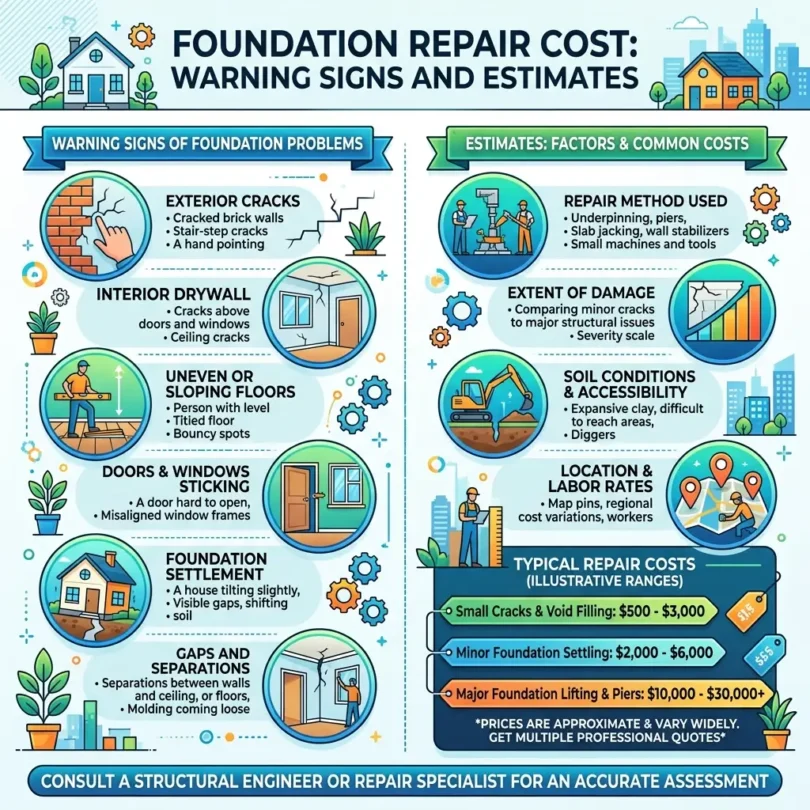
Foundation repair cost can range from a few hundred dollars to tens of thousands of dollars.
General cost ranges:
| Foundation Repair Type | Estimated Cost Range |
|---|---|
| Minor crack repair | $250–$800 per crack |
| Foundation leak repair | $2,000–$12,000 |
| Slabjacking or mudjacking | $1,000–$6,000 |
| Pier installation | $1,000–$3,000+ per pier |
| Settling or sinking repair | $4,500–$20,000 |
| Bowing basement wall repair | $1,600–$11,000 |
| Pier and beam repair | $1,500–$15,000 |
| Major underpinning | $15,000–$30,000+ |
| Severe structural repair | $30,000+ |
These are general planning numbers. Your actual cost may be lower or higher depending on your home, soil, foundation type, repair method, and contractor.
HomeGuide lists bowing basement wall repair at $80 to $550 per linear foot, or about $1,600 to $11,000 on average, depending on method and severity. For pier and beam foundations, HomeGuide lists average repair costs of $1,500 to $15,000, with leveling often costing $1,500 to $10,000.
Foundation Repair Cost by Problem
Different foundation problems require different repair methods.
1. Foundation Crack Repair Cost
Small foundation cracks are usually the least expensive repair.
| Crack Type | Estimated Cost |
|---|---|
| Hairline crack sealing | $250–$500 |
| Epoxy injection | $300–$800 per crack |
| Polyurethane crack injection | $400–$1,000 |
| Structural crack repair | $1,000–$5,000+ |
Some cracks are harmless, but others need professional inspection.
More serious cracks include:
- Horizontal cracks
- Stair-step cracks in brick or block
- Cracks wider than 1/4 inch
- Cracks that keep growing
- Cracks with water leakage
- Cracks with wall movement
- Multiple cracks appearing suddenly
A 2026 homeowner guide on foundation cracks notes that cracks wider than 1/4 inch, growing cracks, horizontal cracks, stair-step cracks, bowed walls, and gaps between walls or floors can be red flags for structural stress.
2. Foundation Leak Repair Cost
Foundation leaks can happen through cracks, basement walls, floor joints, window wells, or poor drainage.
| Leak Repair Type | Estimated Cost |
|---|---|
| Minor crack leak repair | $500–$1,500 |
| Interior drainage repair | $2,000–$8,000 |
| Exterior waterproofing | $5,000–$15,000+ |
| Sump pump installation | $1,000–$4,000 |
| Major basement waterproofing | $8,000–$20,000+ |
Foundation leaks should not be ignored. Water can damage drywall, flooring, insulation, framing, and stored items. It can also increase mold risk.
If the leak is caused by poor drainage, the repair should include drainage correction. Sealing a crack without fixing water pressure may not solve the problem.
3. Settling or Sinking Foundation Repair Cost
Foundation settling happens when part of the home sinks or shifts because the soil under the foundation changes. This may happen because of expansive clay soil, poor compaction, erosion, drainage problems, drought, tree roots, or water movement.
| Repair Method | Estimated Cost |
|---|---|
| Slabjacking | $1,000–$6,000 |
| Foam injection | $2,000–$7,000 |
| Steel piers | $1,000–$3,000+ per pier |
| Helical piers | $1,500–$3,500+ per pier |
| Underpinning | $10,000–$30,000+ |
HomeGuide says foundation repairs for settling, sinking, or bowed walls can cost $4,500 to $20,000, depending on house size and repair method.
Settling repairs can become expensive because they often require lifting, stabilizing, or underpinning part of the structure.
4. Bowing Basement Wall Repair Cost
Bowing basement walls are serious. They often happen when soil pressure, water pressure, or poor drainage pushes against basement walls.
| Bowing Wall Repair Method | Estimated Cost |
|---|---|
| Carbon fiber straps | $350–$1,000+ per strap |
| Wall anchors | $400–$1,200+ per anchor |
| Steel I-beams | $1,000–$3,000+ per beam |
| Wall rebuilding | $10,000–$30,000+ |
| Drainage and waterproofing add-on | $2,000–$15,000+ |
HomeGuide lists bowing basement wall bracing at $80 to $550 per linear foot, or about $1,600 to $11,000 on average. The final cost depends on wall size, severity, and repair method.
A slightly bowed wall may be stabilized with straps or anchors. A severely bowed or cracked wall may need major structural repair.
5. Pier and Beam Foundation Repair Cost
Pier and beam foundations are common in some older homes and certain regions. They may have issues with sagging floors, rotten beams, shifting piers, moisture, crawl space problems, or poor support.
| Pier and Beam Repair | Estimated Cost |
|---|---|
| Adding shims | $800–$3,000 |
| Leveling | $1,500–$10,000 |
| Beam replacement | $2,000–$8,000+ |
| Pier reinforcement | $2,000–$12,000 |
| Crawl space moisture repair | $1,500–$10,000+ |
| Major pier and beam repair | $10,000–$25,000+ |
Angi says pier and beam foundation repair can range from $800 to $25,000, depending on whether the job involves shims, deep supports, waterproofing, permits, drainage, gutters, or crawl space sealing.
Moisture control is especially important for pier and beam homes because crawl space moisture can cause rot and movement.
Foundation Repair Cost by Foundation Type
Foundation type matters because each type fails differently.
Slab Foundation Repair Cost
Slab foundations are common in warm climates. Problems may include cracks, sinking sections, plumbing leaks under the slab, or soil movement.
Estimated cost:
| Slab Repair Type | Estimated Cost |
|---|---|
| Minor crack repair | $250–$800 |
| Slabjacking | $1,000–$6,000 |
| Foam injection | $2,000–$7,000 |
| Pier installation | $5,000–$20,000+ |
| Major slab repair | $15,000–$30,000+ |
Basement Foundation Repair Cost
Basement foundations may have cracks, leaks, bowing walls, water pressure, or settlement.
Estimated cost:
| Basement Repair Type | Estimated Cost |
|---|---|
| Crack sealing | $250–$1,000 |
| Leak repair | $2,000–$12,000 |
| Bowing wall repair | $1,600–$11,000 |
| Exterior waterproofing | $5,000–$15,000+ |
| Wall rebuilding | $10,000–$30,000+ |
Crawl Space Foundation Repair Cost
Crawl space problems often involve moisture, rotten wood, poor supports, sagging floors, or pier movement.
Estimated cost:
| Crawl Space Repair Type | Estimated Cost |
|---|---|
| Support repair | $1,500–$7,000 |
| Beam replacement | $2,000–$8,000+ |
| Encapsulation | $3,000–$15,000 |
| Drainage repair | $2,000–$10,000 |
| Major structural repair | $10,000–$25,000+ |
Pier and Beam Foundation Repair Cost
Pier and beam repair can involve shimming, leveling, replacing beams, reinforcing piers, and managing moisture.
HomeGuide lists pier and beam foundation repair at $1,500 to $15,000 on average.
Warning Signs of Foundation Problems
Foundation problems often show up in small ways before they become serious.
Look for these warning signs:
- Cracks in interior walls
- Stair-step cracks in brick
- Horizontal cracks in basement walls
- Doors that stick
- Windows that do not close properly
- Uneven or sloping floors
- Gaps around windows or doors
- Gaps between walls and ceilings
- Cabinets pulling away from walls
- Cracks in tile floors
- Bowing basement walls
- Water in basement or crawl space
- Chimney leaning or separating
- Cracks wider than 1/4 inch
- Floors that feel bouncy
- Crumbling concrete
- Musty crawl space smell
Alpha Structural lists sticking doors and windows as a warning sign because shifting or settling can misalign frames. Better Homes & Gardens also highlights cracked drywall, poor drainage, sticking doors/windows, bulging floors, large foundation cracks, bowing walls, and exterior siding issues as possible indicators of foundation trouble.
Not every sign proves serious damage, but multiple warning signs should not be ignored.
What Causes Foundation Problems?
Foundation problems usually come from soil, water, construction, or structural movement.
1. Poor Drainage
Water pooling around the home can expand soil, erode soil, or push against foundation walls.
2. Expansive Clay Soil
Clay soil expands when wet and shrinks when dry. This movement can stress foundations.
3. Plumbing Leaks
Leaks under or near the foundation can soften soil and cause movement.
4. Tree Roots
Large trees near the home can affect soil moisture and foundation stability.
5. Poor Soil Compaction
If soil was not compacted properly before construction, settlement can occur.
6. Drought
Dry soil can shrink away from the foundation, especially in clay-heavy regions.
7. Hydrostatic Pressure
Water pressure against basement walls can cause bowing, cracking, and leaks.
8. Poor Construction
Weak concrete, poor footings, bad drainage design, or improper support can lead to problems.
9. Erosion
Water movement can wash away supporting soil.
10. Freeze-Thaw Cycles
In cold climates, water expansion and contraction can worsen cracks over time.
Better Homes & Gardens recently noted that freeze-thaw cycles can cause or worsen cracks because soil and moisture expand and contract, but wider, growing, or horizontal cracks need professional evaluation.
Does Home Insurance Cover Foundation Repair?
Homeowners insurance usually does not cover foundation repair if the damage is caused by normal settling, poor drainage, soil movement, construction defects, wear and tear, or lack of maintenance.
Insurance may cover foundation damage if it is caused by a covered sudden event, such as:
- Fire
- Explosion
- Vehicle impact
- Certain sudden plumbing leaks
- Certain storm damage
- Falling tree
- Vandalism
Insurance usually does not cover:
- Normal settling
- Soil expansion and contraction
- Long-term water seepage
- Poor maintenance
- Tree root damage
- Poor construction
- Flood damage without flood insurance
- Earth movement unless covered by special policy
Always check your policy and ask your insurance company directly. Foundation coverage is very policy-specific.
Foundation Inspection Cost
Before repairing a foundation, homeowners may need an inspection or engineering report.
Estimated costs:
| Inspection Type | Estimated Cost |
|---|---|
| Basic contractor inspection | Free–$500 |
| Structural engineer report | $500–$3,000 |
| Soil report | $500–$3,000 |
| Plumbing leak test | $200–$1,000+ |
Angi recommends budgeting $500 to $3,000 for a soil report so the repair targets the right fix.
A structural engineer may be useful if:
- Cracks are serious
- The home is settling
- Walls are bowing
- You are buying or selling the home
- The contractor recommends expensive repairs
- You want an independent opinion
An engineer does not usually perform the repair, so their advice can be more independent than a sales estimate.
Foundation Repair Methods Explained
Crack Injection
Epoxy or polyurethane injection seals cracks. Epoxy is often used for structural bonding, while polyurethane is often used for water-sealing cracks.
Best for:
- Small cracks
- Leaking cracks
- Minor concrete cracks
Not best for:
- Severe movement
- Bowing walls
- Major settlement
Slabjacking or Mudjacking
Slabjacking pumps material under a sunken concrete slab to lift it.
Best for:
- Sunken slab sections
- Walkways
- Garage slabs
- Some foundation slabs
Not best for:
- Severe structural failure
- Unstable soil without correction
Polyurethane Foam Injection
Foam injection lifts concrete with expanding foam. It is often lighter than mudjacking material.
Best for:
- Concrete lifting
- Slab leveling
- Smaller voids
Not best for:
- Major structural settlement
Steel Piers
Steel piers are driven deep into stable soil or bedrock to support the foundation.
Best for:
- Serious settlement
- Heavy structures
- Long-term stabilization
Not best for:
- Minor cracks
- Surface-level issues
Helical Piers
Helical piers are screw-like steel supports installed into the ground.
Best for:
- Lighter structures
- Certain soil types
- New construction support
- Foundation stabilization
Wall Anchors
Wall anchors stabilize bowing basement walls by connecting the wall to stable soil outside.
Best for:
- Bowing basement walls
- Soil pressure problems
Carbon Fiber Straps
Carbon fiber straps reinforce basement walls and can stop minor bowing from worsening.
Best for:
- Minor to moderate bowing
- Basement wall reinforcement
Not best for:
- Severe wall movement
- Walls needing straightening
Underpinning
Underpinning strengthens or deepens the foundation support.
Best for:
- Major foundation instability
- Settlement
- Structural support needs
How to Reduce Foundation Repair Cost
1. Fix Drainage Early
Poor drainage is one of the biggest causes of foundation damage.
2. Clean Gutters
Clogged gutters dump water near the foundation.
3. Extend Downspouts
Send water away from the home, not beside the foundation.
4. Improve Grading
Soil should slope away from the house.
5. Fix Plumbing Leaks Quickly
Hidden plumbing leaks can weaken soil under the foundation.
6. Monitor Cracks
Take photos and measure cracks over time.
7. Get Multiple Estimates
Compare repair methods, not just prices.
8. Use an Engineer for Big Repairs
An independent engineer can help avoid unnecessary or wrong repairs.
9. Do Not Delay Serious Problems
Waiting can make repairs more expensive.
10. Control Crawl Space Moisture
Moisture can cause rot and pier movement in crawl spaces.
Questions to Ask a Foundation Repair Contractor
Before hiring a contractor, ask:
- Are you licensed and insured?
- How long have you repaired foundations?
- What is causing the problem?
- Do I need a structural engineer?
- What repair method do you recommend?
- Why is this method better than others?
- How many piers or anchors are needed?
- Is drainage repair included?
- Is waterproofing included?
- Are permits required?
- What warranty is included?
- Is the warranty transferable?
- Will the repair stop movement or just seal cracks?
- How long will the work take?
- Will landscaping or flooring be affected?
- Can you provide references?
A good contractor should explain the cause, repair method, expected results, warranty, and risks clearly.
Common Foundation Repair Mistakes
Mistake 1: Ignoring Drainage
If water caused the problem, structural repair alone may not solve it.
Mistake 2: Sealing Cracks Without Finding the Cause
A crack may return if the foundation is still moving.
Mistake 3: Choosing the Cheapest Estimate
Cheap repairs may not address the real problem.
Mistake 4: Skipping an Engineer for Major Repairs
For expensive foundation work, an independent engineering report can be valuable.
Mistake 5: Waiting Too Long
Foundation problems usually get more expensive over time.
Mistake 6: Not Reading the Warranty
Some warranties cover only materials, not future movement.
Mistake 7: Ignoring Crawl Space Moisture
Moisture can damage beams, joists, and supports.
Mistake 8: Assuming Insurance Will Pay
Most foundation issues are not covered unless caused by a covered sudden event.
Final Verdict: How Much Should You Budget for Foundation Repair?
Most homeowners should expect foundation repair to cost somewhere between $2,225 and $8,135 for many standard repairs, but minor cracks may cost only a few hundred dollars and major structural repairs can exceed $20,000 to $30,000.
The cost depends on the real cause of the problem. A small crack may need sealing. A leaking basement may need drainage and waterproofing. A sinking slab may need piering or lifting. A bowing wall may need anchors, beams, or reinforcement.
The smartest approach is to inspect early, control drainage, compare multiple estimates, and get an independent structural engineer involved when the repair is expensive or structural.
Your foundation is not the place to guess. A correct repair can protect your home, prevent future damage, and preserve property value.
FAQs About Foundation Repair Cost
How much does foundation repair cost?
Foundation repair usually costs around $2,225 to $8,135 for many homeowners, but minor crack repair may cost $250 to $800, while major settling, sinking, or bowed wall repair can cost $4,500 to $20,000 or more.
What is the most expensive foundation repair?
Major underpinning, steel pier installation, severe basement wall rebuilding, and structural stabilization are usually the most expensive repairs. Severe cases can cost $15,000 to $30,000 or more.
How much does foundation crack repair cost?
Minor foundation crack repair can cost $250 to $800 per crack, depending on crack size, repair method, and whether water is leaking.
How much does bowing basement wall repair cost?
Bowing basement wall repair can cost about $80 to $550 per linear foot, or $1,600 to $11,000 on average, depending on repair method and severity.
How much does pier and beam foundation repair cost?
Pier and beam foundation repair usually costs $1,500 to $15,000 on average, while some repairs can range from $800 to $25,000 depending on supports, shims, moisture, and structural work.
What are warning signs of foundation problems?
Warning signs include wall cracks, stair-step brick cracks, sticking doors and windows, uneven floors, gaps around windows, bowing basement walls, basement water, chimney separation, and cracks wider than 1/4 inch.
Does homeowners insurance cover foundation repair?
Usually not if the damage is caused by settling, soil movement, poor drainage, wear and tear, or maintenance problems. Insurance may cover foundation damage if caused by a covered sudden event.
Can foundation repair be DIY?
Minor cosmetic crack sealing may be DIY in some cases, but structural foundation repair should be handled by professionals.
Should I get a structural engineer for foundation repair?
Yes, if the damage is serious, the repair estimate is expensive, walls are bowing, the home is settling, or you want an independent opinion before hiring a contractor.
How can I prevent foundation problems?
Improve drainage, clean gutters, extend downspouts, fix plumbing leaks, maintain consistent soil moisture, control crawl space moisture, and monitor cracks over time.